Dye migration happens when heat turns polyester’s disperse dye to vapour that moves into a DTF transfer’s adhesive and white ink, tinting the white at the press or days later. Makers put the onset at 127–149 °C (260–300 °F), overlapping DTF’s polyester settings. Press as low as your powder’s sheet allows, use low-melt or blocker powder on bleeders, cool garments unstacked and recheck tests after 72 hours.
DTF on polyester and performance fabrics at a glance
Performance fabrics fail in two ways: dye moves into the print, or the print never bonds. Press numbers follow the DTF heat press settings guide, which assumes standard hot-melt powder unless a row names another; your own film or powder sheet overrides both.
| Fabric | Main risk | Press direction | Powder | Test before the run | Use another row when… |
|---|---|---|---|---|---|
| 100 % polyester, white or pastel | Low | Polyester row: 140–150 °C (284–302 °F) on most sheets, with the sheet’s own time | Standard | One transfer, rechecked at 24 hours | It carries a sublimated print |
| Dark or bright dyed polyester, polyester-rich blends and tri-blends | Dye migration: the white takes on the garment’s colour | Bottom of the row: 140 °C (284 °F), or 135 °C (275 °F) with STS P-6 low-melt powder | Low-melt or blocker | Kraft-paper test, then a white patch at 24 and 72 hours | Mostly cotton: blends row of the settings guide |
| Sublimated, camo-on-dyed and team jerseys | The heaviest migration | The lowest setting the powder allows; omit only an optional second press | Blocker | White patch held 72 hours, or 2–5 days at 40 °C (104 °F) | Never: treat every one as a bleeder |
| Polyester/spandex performance knits (e.g. 88/12) | Migration plus cracking on stretch | Start at 140 °C (284 °F) | Low-melt or blocker; check its sheet for stretch | White patch plus a stretch test | Mostly cotton: last row |
| Nylon, uncoated | Glazing, shrinking, weak adhesion; migration less likely | Start at 138 °C (280 °F) | One whose sheet lists nylon | Inside-hem press; peel and scratch when cool and at 24 hours | Water beads on it: next row |
| Water-resistant or coated (durable water-repellent finish, PU or silicone coat) | The adhesive does not bond | Start at 138 °C (280 °F); never add heat to force a bond | One whose sheet lists coated fabrics | Water-drop test, then peel, scratch and wash test | Supplier confirms no finish: the fibre’s own row |
| Cotton/spandex (e.g. 95/5) | Cracking on stretch; migration low | 150 °C (302 °F), the bottom of the cotton row | Stretch (flex) powder | Stretch test once cool | Mostly polyester: polyester/spandex row |
What is dye migration, and why does it happen on polyester?
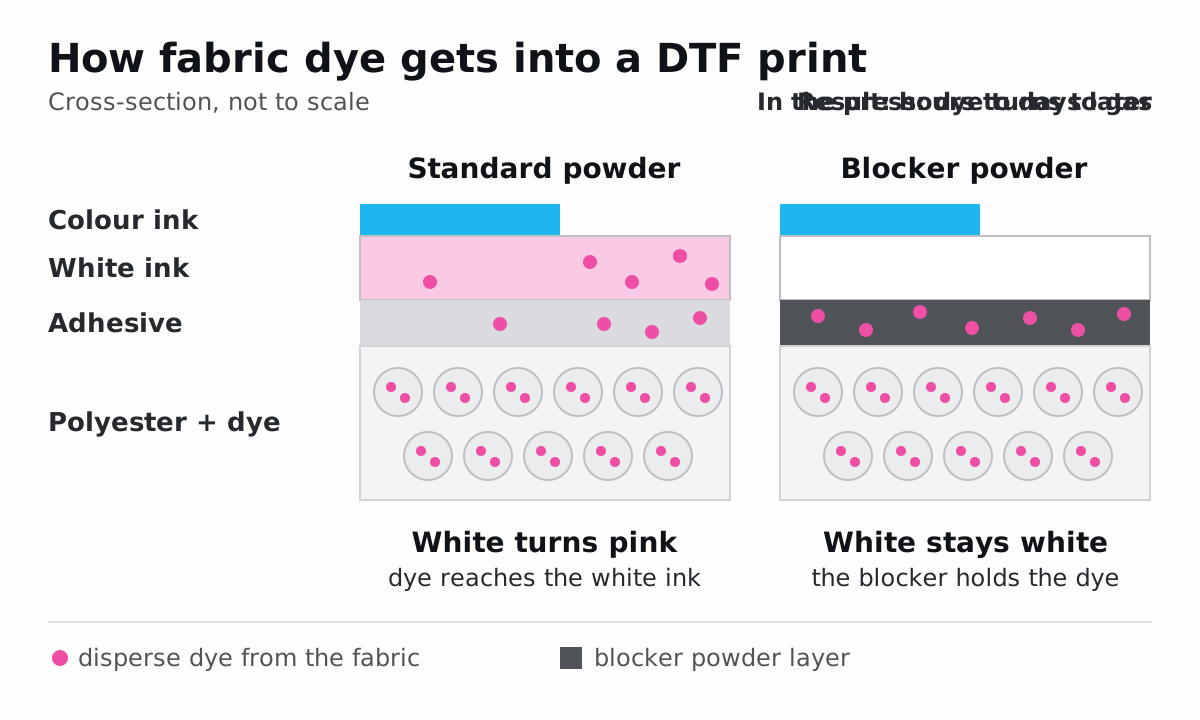
Avient, the maker of Wilflex inks, defines dye migration as “the movement of dye from a dyed material (t-shirt) to another material (ink) in contact with the dyed material”. In a DTF transfer that material is the print: from the fabric up, a layer of hot-melt adhesive, then the white underbase, then the colour inks. Four facts explain why polyester does this and cotton rarely does.
- Polyester is coloured with disperse dyes. These small dye molecules do not dissolve in water and are driven into the fibre with heat. STAHLS’ describes polyester dyeing as using “heat and pressure … to open the polyester polymers just enough to deposit dye into the fiber”; textile chemists dye it at about 130 °C (266 °F). Reheating opens the fibre again.
- Heat turns the dye into a gas. Above a threshold the dye sublimates: in Avient’s words, “the dye changes from a solid to a gas” and leaves the fibre. A heat press supplies that heat, pressed flat against the fabric.
- The print takes the dye up. In screen printing, the ink’s plasticiser “wants to pull those dye molecules into itself” (International Coatings). In DTF the first layer the dye meets is the adhesive, commonly thermoplastic polyurethane (TPU), as STS and DTF Station list for their powders. Spandex is also a polyurethane, and with a glass transition (the point where a polymer softens) below room temperature it will “readily absorb disperse dyes”, textile chemists note.
- The dye keeps spreading after the press opens. Avery Dennison’s patent for transfers on sublimated sportswear calls dye diffusion “thermodynamically driven by the dye concentration gradient” and “facilitated by heat encountered from a variety of sources during manufacture and use”. Dye moves from where it is concentrated to where it is not, faster when warm, and a polymer that stays soft at room temperature does not stop it.
Why it can appear hours or days later
STAHLS’ says migration “can happen immediately at the heat press or even up to 72+ hours later”; SanMar, which supplies blank garments to decorators, says it “may not occur for hours or days”. Three things keep it going:
- Heat that stays in the garment. International Coatings warns that stacking garments before they cool “only traps the heat longer and exacerbates the problem”; Avient lists garments “hot stacked or placed in boxes while the substrate is warm” among the causes.
- Heat that comes later. “Any time a polyester garment is exposed to heat it can migrate, like in a clothes dryer or hot car” (STAHLS’).
- A blocker that fills up. Independent Trading Co., a blank-garment maker, compares the grey blocker in its screen-printing recipe to “a sponge, once it is filled it can’t absorb anymore”, which is why an overheated garment can show migration later.
Why white and light colours show it first
Avient’s guide says the colour shifts appear “particularly in light or white inks”. White reflects every colour, so any dye inside it shows, and in a DTF transfer the white is also the ink nearest the fabric; where the design is white only, nothing covers it. Dark colours hide the same dye: on low-bleed polyester, STAHLS’ notes, a dark-coloured vinyl means “any dye migration will not be visible”.
STAHLS’ also finds that “dark shades are more likely to migrate than light/white shades”, gives “a faint red (or pink) number on a red jersey” as the classic case, and names “CamoHex, reversible jerseys, and tri-blends with heavy polyester content” as known bleeders. Sublimated fabric is the extreme: Avient calls sublimation dyes “one of the worst culprits” and advises a blocker whenever the fabric is sublimated.
At what temperature do polyester dyes start to migrate?
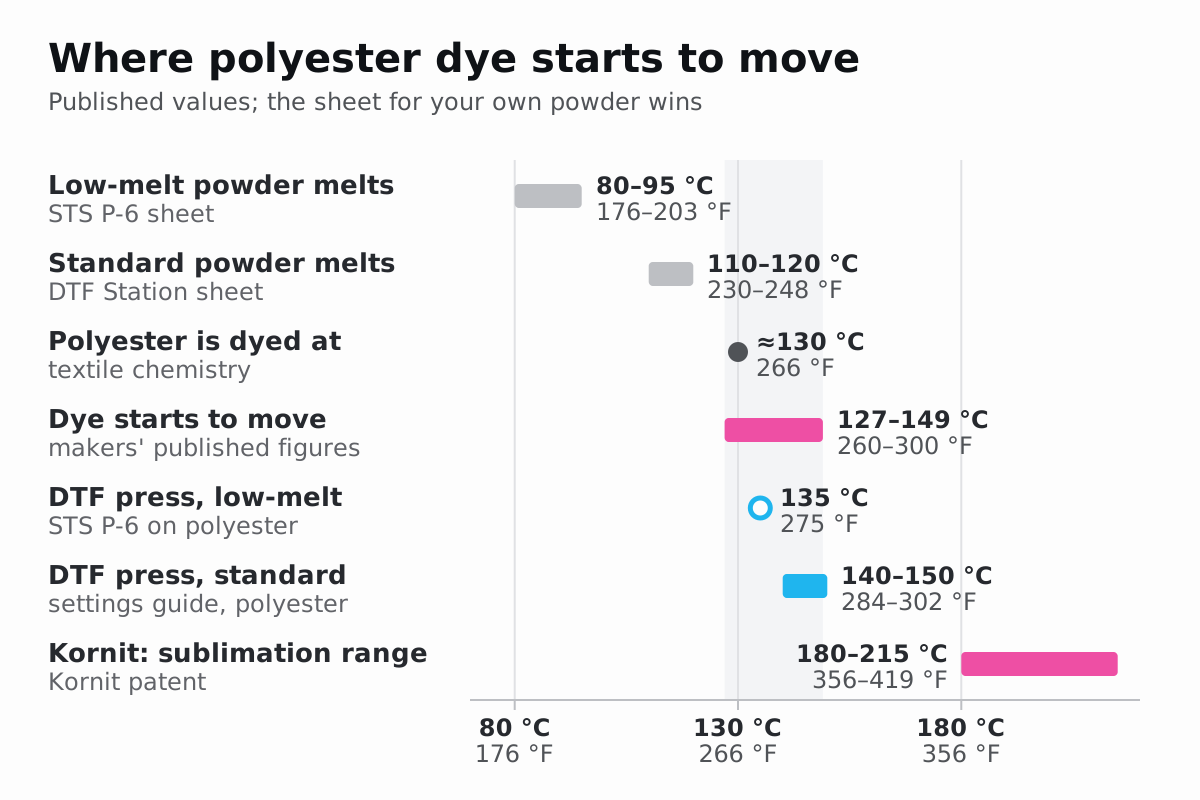
There is no single number. Ink, transfer and garment makers put the start between 127 °C and 149 °C (260–300 °F), and a printer maker’s patent puts outright sublimation at 180–215 °C (356–419 °F):
| Published by | Kind of maker | What they say | °F | °C |
|---|---|---|---|---|
| International Coatings | Screen-printing ink | Once heat “passes the 260º F threshold, the polyester dyes will often get released” | 260 | 127 |
| Avient (2020 bulletin) | Screen-printing ink | Migration occurs when the garment is heated “in excess of” this | 265 | 129* |
| STAHLS’ | Heat transfers | Above this the dyes “are reactivated and released” | 280 | 138 |
| Avient (2025 guide) | Screen-printing ink | Migration is “more apparent when curing at temperatures over” this | 290 | 143 |
| Independent Trading Co. | Blank garments | ”At 300 Degrees Polyester Dyes gas off and migrate into the ink” | 300 | 149 |
| Kornit Digital (patent) | Inkjet garment printers | ”Migratable dyes sublimate at temperatures ranging from 180-215° C.” | 356–419 | 180–215 |
*Avient prints 265 °F as 130 °C; the exact conversion is 129 °C. Conversions use °C = (°F − 32) × 5/9, rounded, from the unit the maker published.
The spread has three causes:
- Dyes differ. “Dyes migrate at different temperatures,” says Avient’s curing guide; its 2025 guide adds dyes that “are not fully set” or come from sublimation. STAHLS’ sees variation “even from one dye lot to the next”, so one batch of a garment can pass at 140 °C (284 °F) and the next can bleed.
- The figures are not universal thresholds. These publications describe different dyes and processes; their figures do not establish separate universal thresholds for migration and sublimation. Across all of them, more dye moves the hotter it gets.
- Time counts too. The screen-printing figures come from dryers, where plastisol must reach 320 °F (160 °C) “for up to 1 minute” (International Coatings). A DTF press holds polyester for 12–15 seconds, a fifth to a quarter of that minute. In a study of sublimation transfer onto polyester, Adel and co-authors found dye release “in direct relationship with time and temperature”.
For DTF this means a standard polyester press at 140–150 °C (284–302 °F) is already above the 127–138 °C (260–280 °F) where International Coatings, Avient and STAHLS’ put the start, and level with Independent Trading’s 149 °C. A low-melt powder such as STS P-6, pressed at 135 °C (275 °F), narrows the gap without closing it. Temperature decides how much dye moves; the powder and the test decide whether that amount shows.
How do you spot dye migration?
Look for the garment’s own colour inside the print: the white turns a paler version of it and light inks shift towards it. The tint can be there at the peel or build over the following days, and it often starts at the edges. Avery Dennison’s patent notes that “dye diffusion often occurs along the outer perimeter of the heat transfer”, leaving a “halo effect”, “an undesirable ring around the outside of the transfer”. Other faults also put colour in the wrong place; sort them by when they appear:
| What you see | When it appears | What it is | How to confirm |
|---|---|---|---|
| White or light colours tinted the fabric’s colour | At the peel, or growing over hours to days | Dye migration | A cotton control stays white while the polyester print changes by 72 hours |
| A coloured ring around the edge of the print | Hours to days after pressing | Dye migration at the edge (the “halo effect”) | The ring matches the fabric colour and widens over time |
| Fabric colour faintly visible through the white, evenly | At the peel, and never changes | Thin white: an opacity problem, not migration | It looks right on a white garment, and the cast never grows |
| Shiny, darkened or box-shaped marks on the fabric around the print | At the press | Scorch or glaze from heat or pressure | The marks sit on bare fabric outside the print |
| A shiny outline hugging the design | At the press | Stray powder melted onto the fabric | Powder sat outside the print on the film |
Opacity and migration are different faults, STAHLS’ stresses: migration “is caused by the actual dye of the fabric releasing and becoming part of the transfer”. The last two rows are pressing faults, fixed in the settings guide.
How do you test a polyester garment before the run?
Test every new garment style, and every new colour of a known style, before the first paid print. You need a spare garment (or an inside hem), kraft paper and a few small transfers. Avient’s bleed test prints white ink only, because white shows migration first; do the same.
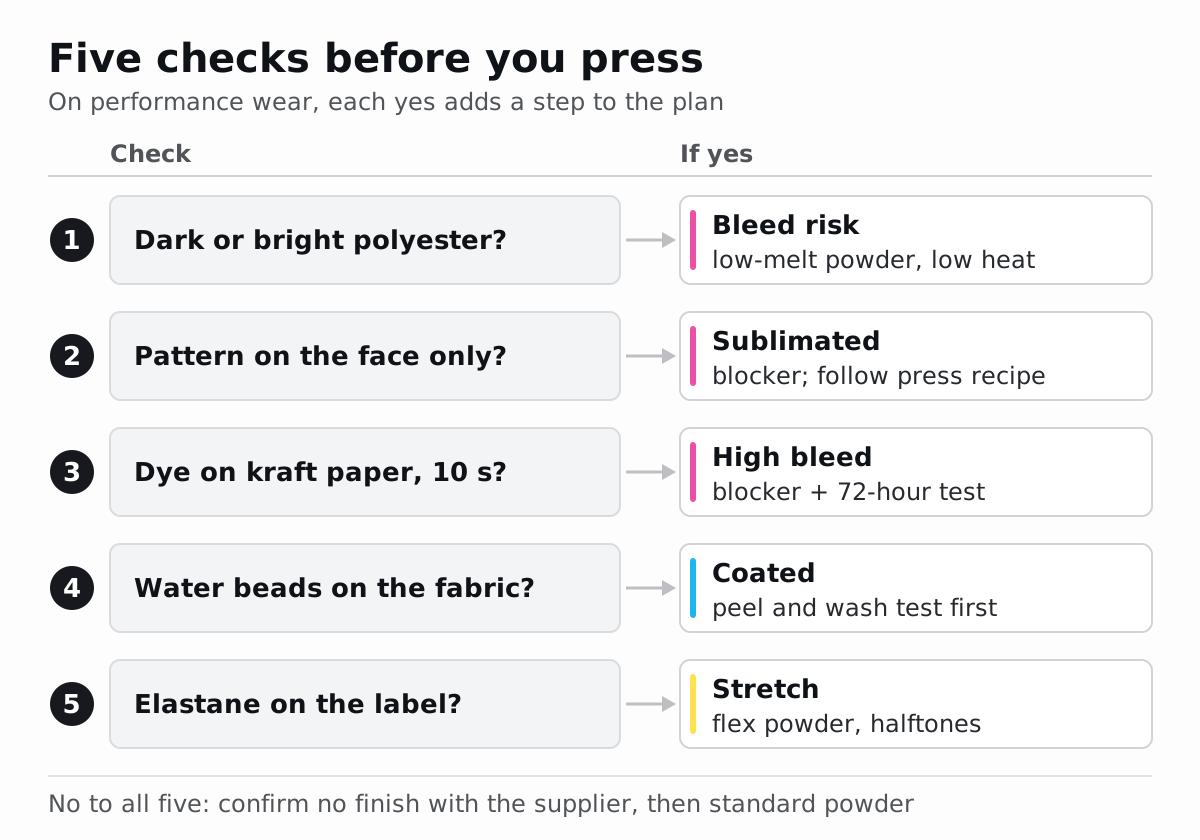
- Read the label and the inside. STAHLS’ tells decorators to treat a tri-blend with a high polyester share “as if it might migrate”. Then turn the garment inside out: the same colour inside as on the face means dyed fabric; a plain inside under a pattern on the face means a sublimated print, the hardest case. Pass: you can name the garment’s row in the table at the top.
- Run the kraft-paper test. STAHLS’ method: cover the bare garment with kraft paper and press for 10 seconds, here at your planned temperature. “With unstable inks, you’ll see ink residue on the cover sheet.” Pass: clean paper. Colour on it marks a high-bleed garment: plan for a blocker powder.
- Print the test transfers: a solid white square of about 50 × 50 mm (2 × 2 in) and a small piece of the real design, twice, one set for the garment and one for a white cotton control.
- Press both at the production settings: the same temperature (measured on the platen, not read off the display), dwell (press time), pressure, cover sheet and peel as the run.
- Cool the garment flat and on its own, never on another warm garment.
- Compare at the peel, after 24 hours and after 72 hours, against the control in daylight, white square and edges first. International Coatings recommends “waiting at least two days after doing a test print, or over the weekend”. Avient’s laboratory version holds white prints for three weeks, or for 2–5 days at 40 °C (104 °F) when it needs the answer sooner.
- Wash the sample after 24 hours, inside out at the care-label temperature; Avient’s own wash test runs polyester at 40 °C (104 °F) for five wash-and-dry cycles.
The garment passes when, after 72 hours and the wash, its white square cannot be told apart from the control: no cast, no ring at the edge, no lifting. Record the style, colour, powder and settings so the next order starts from evidence. If it fails, work down the list in the next section with fresh transfers. If a blocker powder at its lowest setting still tints at 72 hours, the garment is not a DTF job; tell the customer before printing. The file side of a test print is covered in the DTF test-file guide.
How do you prevent dye migration in DTF?
No setting removes the risk on a garment that bleeds. These steps reduce how much dye moves, then trap or hide what does; the first ones cost nothing.
- Start from a garment that holds its dye. SanMar, for example, sells PosiCharge styles that “have a heat set dye to help prevent dye migration”. Ask your blank supplier which styles it rates as low-bleed, and quote sublimated or camo-on-dyed blanks only with a blocker powder and a test.
- Press at the bottom of your supplier’s polyester range: for example 140 °C (284 °F) with standard powder where the sheet allows it, and never above the range your transfer supplier has validated. STAHLS’ says to set the temperature “as low as possible (within the material’s recommended application temperature range)”; Avient, “the lower the temperature the better”. Go below your powder’s range and the adhesive does not flow, so the print fails in the wash instead (see the peeling and washing guide).
- Change the powder on bleeders. On dark or bright polyester, use a low-melt powder: STS calls its P-6 polyurethane powder, melting at 80–95 °C (176–203 °F), “low dye migration” and suggests 135 °C (275 °F) for 15 seconds on polyester, 5–15 °C (9–27 °F) below the standard row. On sublimated and high-bleed garments, use a blocker powder (next section).
- Add no heat you do not need. Press for the dwell on your film or powder sheet, usually 12–15 seconds, not longer “to be safe”: more time moves more dye. Keep the pre-press to the few seconds that drive out moisture and skip any second press the sheet calls optional.
- Cool garments fast and apart. Lay them flat on a table or rack, never on each other while warm, and fold or bag them only when cool. SanMar’s advice to screen printers is to “make multiple stacks” and put fans at the end of the dryer.
- Keep the white at full strength on bleeders. Avient counts a too-thin ink layer among the causes, and STAHLS’ says a thick, opaque layer “will inhibit dye migration in most low–bleed fabrics”. It buys margin; it does not block.
- Pass the care advice on. A tumble dryer or a car parked in the sun reheats the garment. Wash inside out at the care label’s temperature and dry at low heat or on a line.
Powder goes onto the whole printed sheet at once, so a sheet carries one powder. Keep dark-polyester orders on their own gang sheet with the low-melt or blocker powder instead of mixing them into a cotton run. In NestSheet each sheet is prepared and exported as its own batch: start a New sheet for those orders, add only their designs with their print sizes and copies, then switch to Manual and place two or three small test transfers at the end of the sheet, where they are easy to cut off for the 72-hour check. The nesting guide shows both placement modes.
Which powder: standard, low-melt, blocker or stretch?
The adhesive powder is the one DTF material that touches the fabric, so it is where migration is fought. Three kinds matter:
| Powder | Published example | What it does about migration | Use it on | Limit |
|---|---|---|---|---|
| Standard or flex (stretch) TPU | DTF Station Color Prime Flex: melts at 110–120 °C (230–248 °F), sold for “superior stretchability” on stretchy fabrics | Nothing in itself; it needs the full 140–150 °C (284–302 °F) polyester press | Cotton, blends, white and light polyester, spandex blends | Tints on any garment that bleeds |
| Low-melt, low-migration TPU | STS P-6: melts at 80–95 °C (176–203 °F); polyester 135 °C (275 °F), 15 s | Lets you press 5–15 °C (9–27 °F) cooler, so less dye moves | Dark and bright dyed polyester; heat-sensitive fabrics | Still above the 127–129 °C start given by International Coatings and Avient |
| Blocker: black, grey or “anti-sublimation” | The maker’s own sheet; few publish what does the blocking | Catches dye in the adhesive layer before it reaches the white | Sublimated, camo and team kit; anything that failed the kraft-paper test | It fills up, so it still needs the lowest heat the sheet allows |
The blocker idea is well documented in screen printing. Avient calls a blocking ink printed first “the most reliable method for controlling bad bleeders” because it will “absorb migrating dyes before they get to subsequent layers of ink”. Independent Trading’s grey blocker works by “absorbing gasses if the garment is over heated”, and it finds grey blockers “tend to provide a better barrier” than white ones. Avery Dennison’s patent fills its barrier layer with “highly adsorbent” materials “such as activated carbons”. In DTF the only layer under the white is the adhesive, so a blocker powder puts the barrier there.
Two limits follow. A blocker has a capacity, like Independent Trading’s sponge, so one pressed too hot can still fail days later. And blocking chemistry inside the white alone is weaker than a barrier: Avient says low-bleed white inks “are not always strong enough to block all of the worst migrating dyes”, and Kornit’s patent describes dye that “simply overpowers the ink’s ability to block its migration”. Pair the blocker with low heat and prove the pair with the 72-hour test.
Read two numbers on every powder sheet: the melting range and the press setting for polyester. A lower melt only helps if the sheet also lets you press lower, because the press setting decides how much dye moves.
How do you press DTF on nylon?
Nylon swaps one problem for others. Avient lists “100% nylon or nylon blends” among the fabrics that reduce the likelihood of dye migration, but nylon is heat-sensitive and often finished to shed water. Independent Trading warns against “burning or shrinking nylon” and says the nylon straps on one of its bags can shrink above 260 °F (127 °C). Ninja Transfers adds that nylon with water-resistant treatments “may not allow the transfer to adhere properly or may be damaged by heat”.
- Read the label. A nylon/polyester blend face brings the migration rules back.
- Do the water-drop test in the next section. If the water beads, treat the garment as coated.
- Start at 138 °C (280 °F) for 12–15 seconds at medium pressure: Ninja’s starting point for delicate fabrics and the nylon row of the settings guide. Use a powder whose sheet lists nylon.
- Watch the fabric, not just the print. Shine, a glazed patch or puckering around the print means too much heat or pressure; reduce pressure first, then temperature.
- Test adhesion before quoting with the peel, scratch and wash checks below, on an inside hem or a spare.
If the bond holds only at a temperature that marks the fabric, offer another decoration, such as embroidery or a sewn patch, rather than turning up the heat.
How do you test water-resistant and coated fabrics?
Water-resistant outerwear often carries a durable water repellent (DWR) finish, which GORE-TEX describes as forming “an ultra-thin layer on the face textile’s surface, reducing surface energy so water rolls off rather than soaking in”. Melted adhesive also has to wet the surface and flow into it, so a finish built to shed liquids works against the bond. Heat does not remove it either: GORE-TEX tells owners to reactivate a tired DWR “via the wash and heat process”, so a longer pre-press will not strip it. Two tests decide whether a coated garment can take DTF.
Water-drop test (one minute):
- Put three or four drops of water on the print area, or on a matching inside area.
- Watch them for a minute.
- Drops that stay round or roll off point to a water-repellent finish. Water uptake alone cannot show that there is none, so confirm with the garment supplier and a transfer wash test; a garment without a finish follows its fibre’s row.
Peel, scratch and wash test (one day):
- Press a small test transfer at the starting setting on an inside hem or a spare garment.
- When it is fully cool, try to lift a corner with a fingernail and scratch firmly across the edges.
- Fold and flex the fabric under the print while watching the edges, where a weak bond lets go first.
- After 24 hours, repeat steps 2 and 3; then wash the sample inside out at the care-label temperature and repeat them once more.
Pass: no corner lifts, the edges stay down when flexed, and nothing changes after the wash. A lifted corner at any stage is a fail, and raising the temperature to force the bond risks trading a peeling print for a marked garment. Other causes of wash failure are in the peeling and cracking guide. Do not strip the finish with solvents to make a print stick: it is part of what the customer paid for.
What changes on spandex and stretch performance wear?
Elastane, sold as spandex or Lycra, gives a fabric stretch that a stiff print cannot follow, and it is heat-sensitive: Ninja warns that “materials with high elastane content can melt or lose their stretch properties when exposed to heat”. Performance knits pair elastane with polyester, so they carry both risks, and textile chemistry adds a reason to expect loose dye: spandex will “readily absorb disperse dyes” in dyeing, later heat-setting moves that dye towards the fibre surface, and in laundering it is “easily released” (Rahman and co-authors).
- Press at the bottom of the main fibre’s row: 140 °C (284 °F) for polyester-rich blends, 150 °C (302 °F) for cotton-rich ones. On dark polyester/spandex, use the low-melt or blocker powder as for any bleeder.
- Use a powder sold for stretch, such as DTF Station’s Color Prime Flex, which its maker says gives “superior stretchability” on stretchy fabrics.
- Break up large solid areas. A continuous patch of white ink and adhesive has to stretch as one piece. In your design software, turn big solids into a halftone or knock out areas so the garment shows through, then upload the finished PNG.
- Run a stretch test, Avient’s method: once the print is at room temperature, hold 5 cm (2 in) of it against a ruler, stretch slowly until the first crack and record that stretch. A fabric can only be tested as far as it stretches itself.
Pass: the print reaches the stretch the garment gets in wear without cracking, before and after the wash test; Avient repeats the stretch test after the last wash because “prints will always show a reduction of stretchiness after washing”. Hairline cracks mean the powder, the setting or the size of the solid areas has to change.
Sources
- Avient, Screen printing dye migration guide: tips and techniques (technical bulletin): https://www.avientspecialtyinks.com/sites/default/files/2020-07/specialty-inks-dye-migration-technical-bulletin.pdf
- Avient, Wilflex solution guide: dye migration: https://www.avientspecialtyinks.com/sites/default/files/2026-01/Wilflex%20Solution%20Guide_Dye%20Migration%20%281%29.pdf
- Avient, Wilflex tips and techniques: ink curing tips: https://www.avient.com/sites/default/files/2020-09/wilflex-ink-curing-tips-2020.pdf
- International Coatings, Understanding polyester printing and dye migration: https://www.iccink.com/blog/understanding-polyester-printing-and-dye-migration
- STAHLS’, Handbook: dye migration: https://assets.stahls.com/stahls/content/pdf/ebooks/Stahls-Dye-Migration-Handbook.pdf
- SanMar, Winning the battle against dye migration: https://www.education.sanmar.com/decorator-relations/winning-the-battle-against-dye-migration/
- Independent Trading Co., Printing tips (polyester, nylon, blends and DTF transfer notes): https://www.independenttradingco.com/pages/printing-tips
- Kornit Digital, Inkjet printing on dyed synthetic fabrics (patent US 11530330 B2): https://patents.google.com/patent/US11530330B2/en
- Avery Dennison, Heat transfers suitable for application on dye sublimation apparel (patent US 9193204 B2): https://patents.google.com/patent/US9193204B2/en
- STS Inks, P-6 DTF transfer low-migration powder: https://www.stsinks.com/product/p-6-dtf-transfer-low-migration-powder/
- DTF Station, Color Prime Flex hot-melt powder: https://shop.dtfstation.com/products/color-prime-flex-hot-melt-powder-for-direct-to-film
- Ninja Transfers, How to prevent scorch marks when pressing DTF transfers: https://ninjatransfers.com/pages/how-to-prevent-scorch-marks-when-pressing-dtf-transfers
- GORE-TEX, Durable water repellent (DWR): https://www.gore-tex.com/support/care/dwr
- Rahman, M. M. et al., Low-temperature dyeing of chemically modified PET/spandex blends, Molecules (2025): https://pmc.ncbi.nlm.nih.gov/articles/PMC12430684/
- Adel, A. M. et al., Exploration on ability of printable modified papers for the application in heat sublimation transfer printing of polyester fabric, Scientific Reports (2023): https://pmc.ncbi.nlm.nih.gov/articles/PMC10121600/